Plant Science &
Conservation
Garden Stories
From Student to Scientist
A Full-Circle Journey at the Chicago Botanic Garden
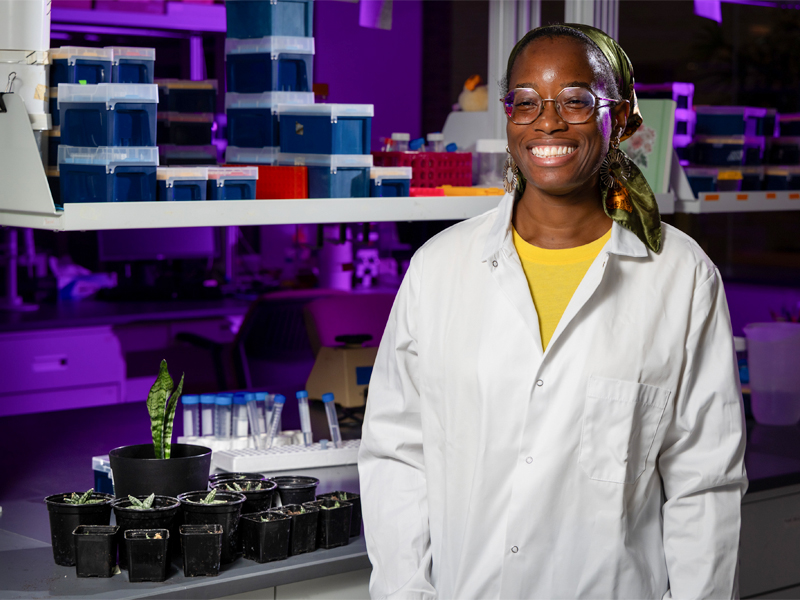
Growing up, Evana James always thought she would become a marine biologist, but an early introduction to plant science through the Chicago Botanic Garden’s Science First program in middle school changed the course of her life.
“I realized these organisms, which had basically been set dressing in my day-to-day life, are actually interesting lifeforms,” James said, reflecting on her time in the program. Science First is also where she discovered that she was better suited to studying plants, anyway. “Plants seemed less scary than the deep sea,” she joked. Once she learned about plant genetics through the Garden’s College First program in high school, her interest “really took off,” she said.
That interest eventually led James to the Research Experiences for Undergraduates (REU), a Garden paid internship program. During the summer between her sophomore and junior years of college, James spent 10 weeks commuting with fellow interns to the Garden, specifically the labs within the Daniel F. and Ada L. Rice Plant Conservation Science Center. There, she worked alongside and was mentored by doctoral students in the Graduate Program in Plant Biology and Conservation, a partnership program between the Garden and Northwestern University.
Under the supervision of her advisor, James contributed to research on a rare and critically endangered plant native to the Hawaiian Islands, a succulent known as alula, or “cabbage on a stick.” The experience provided hands-on training with laboratory equipment and techniques, including DNA sampling and sequencing. But the summer wasn't all work. James recalls plenty of fun moments in the lab. “We were listening to Harry Potter audiobooks and playing Led Zeppelin,” she said. “It was just a fun time.”
At the end of the program, James and the other interns presented their work in a celebration of the summer together. As she assembled her findings into a cladogram tree—a branching diagram used to evaluate genetic relationships among individuals within a species—James had an “a-ha” moment. “All that research actually turned into something!” she said.
Today, James is a doctoral student in the very same graduate program her advisor was all those summers ago, and she credits her wealth of experiences at the Garden with setting her on the path toward a Ph.D. She currently studies the genetic properties of Sansevieria, more commonly known as the snake plant, and will be mentoring her first REU student this summer in what she describes as a full-circle moment. “As Evana’s trajectory demonstrates, the Science Career Continuum is a wonderful way for students to be introduced to what a job in the plant sciences can look like,” said Kay Havens, Ph.D., Chief Scientist of the Garden’s Negaunee Institute. “It helps demystify the field, helps students see themselves as scientists, and for many is their first step into a meaningful career.”
20 Years of Changing Lives
The REU and Graduate Program in Plant Biology and Conservation demonstrate the lasting impact of hands-on learning, mentorship, and scientific discovery. Both programs are celebrating their 20th anniversary this year—two decades of supporting budding scientists from one generation to the next.