Smart Gardener
Tracks in the Snow
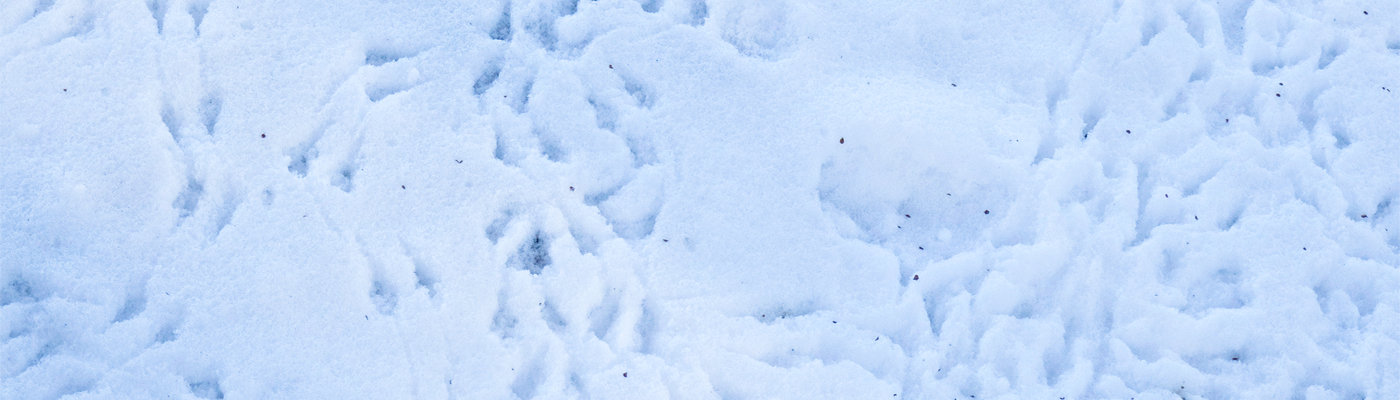
On snow sifted over the December landscape, you see a square of four tiny paw prints, then a stroke, then another square, then another stroke—the mark made by the flopping tail of a scampering deer mouse. "It leaves a hyphen," said Jim Steffen, former senior ecologist at the Garden.
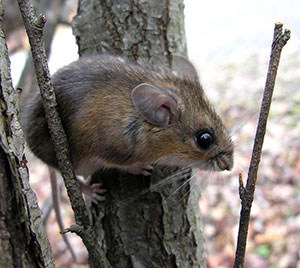
Deer mouse by Bev Wigney.
Deer mice, or white-footed mice, are among the animals you are most likely to see at the Garden in winter—or at least you may see their tracks. And you might hear the hoot of an owl or see the tracks of coyotes, which are also looking for mice.
We tend to think of winter as a time when animals curl up and hibernate like bears. Many do, such as the Garden's woodchucks, 13-lined ground squirrels, and chipmunks. But you can see a lot of activity here in winter, just as in your backyard, if you look for it.
Deer mice, like the meadow voles in the prairie, must be out and about all winter, searching for food. When they can, voles will burrow under the snow or through mulch to nibble on the tender bark of young trees, which makes them unpopular with gardeners.
Short-tailed shrews and masked shrews are also active. These mouse-sized carnivorous mammals have high metabolisms and must eat their body weight every day, Steffen said. They hunt spiders, earthworms, and beetle larvae under the snow.
Winter is a great time to observe a number of bird species at the Garden.
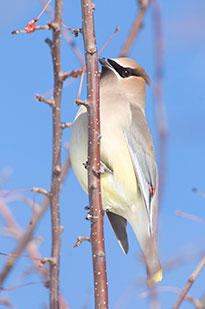
Cedar waxwing eating crabapples
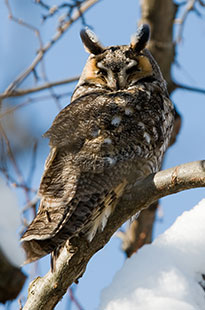
A young long-eared owl in the English Walled Garden puffs up for warmth on a chilly winter morning.
Species of birds
Among the animals that have been seen at the Garden are 260 different species of birds. Most are passing through, but some are commonly seen in the winter, including the familiar black-capped chickadees and goldfinches that gather at bird feeders, as well as cedar waxwings, downy woodpeckers, and red-bellied woodpeckers.
Planning your choice of plants
The Garden's fruiting shrubs and trees from around the world encourage some otherwise migratory birds, such as hermit thrushes, to spend the winter here, said Steffen. It's a reminder that what you choose to plant makes a big difference in what wildlife you see.
Winter wildlife
The Garden keeps an area of water from icing over for the benefit of the resident trumpeter swans, and the open water also attracts some ducks that would otherwise be likely to move on, such as common goldeneyes and buffleheads.
There are also red-tailed hawks and Cooper's hawks, Steffen said, as well as the occasional great horned owl or screech owl. Except for Cooper's hawks, they are all connoisseurs of rodents.
Squirrels too are rodents. At the Garden, you may see common grey squirrels or black squirrels—simply grey squirrels with black fur. You may also spot the less common fox squirrels that are larger, with a hint of orange in their grey coat. At night, McDonald Woods rustles with the movement of nocturnal flying squirrels.
Birds of prey rarely tangle with potentially fierce full-grown squirrels, Steffen said. Instead, the squirrels' chief enemy is the weather. They must huddle against winter storms in the nests, or dreys, they build from fallen leaves in tree cavities or on high branches. These nests are easy to spot in winter.
In the wild woods, squirrels must last on whatever food they managed to stash in fall, if they can remember where they put it. In backyards, squirrels have it easier with ongoing access to bird feeders.
Along the water by the Dixon Prairie, you may see the tracks of sleek water-loving minks. Curious, adaptable raccoons are everywhere. A plop in open water may be a muskrat, looking for vegetation to munch. Sometimes, in the woods, you may feel a coyote watching.
"Wild animals should be viewed at a respectful distance and allowed to go about their business. Good wildlife observers never approach wild animals too closely," advised Steffen.
Bring a pair of binoculars, a winter field guide, and an observant eye.
The signs of life in winter are there to see and hear.
Beth Botts is a garden writer and speaker who lives and gardens in Oak Park, Illinois.