Plant Science & Conservation
Garden Stories
The Secret to Keeping Corpse Flowers Blooming
When our titan arums bloom, scientists work behind the scenes on a genetic rescue mission that could determine the future of the species.
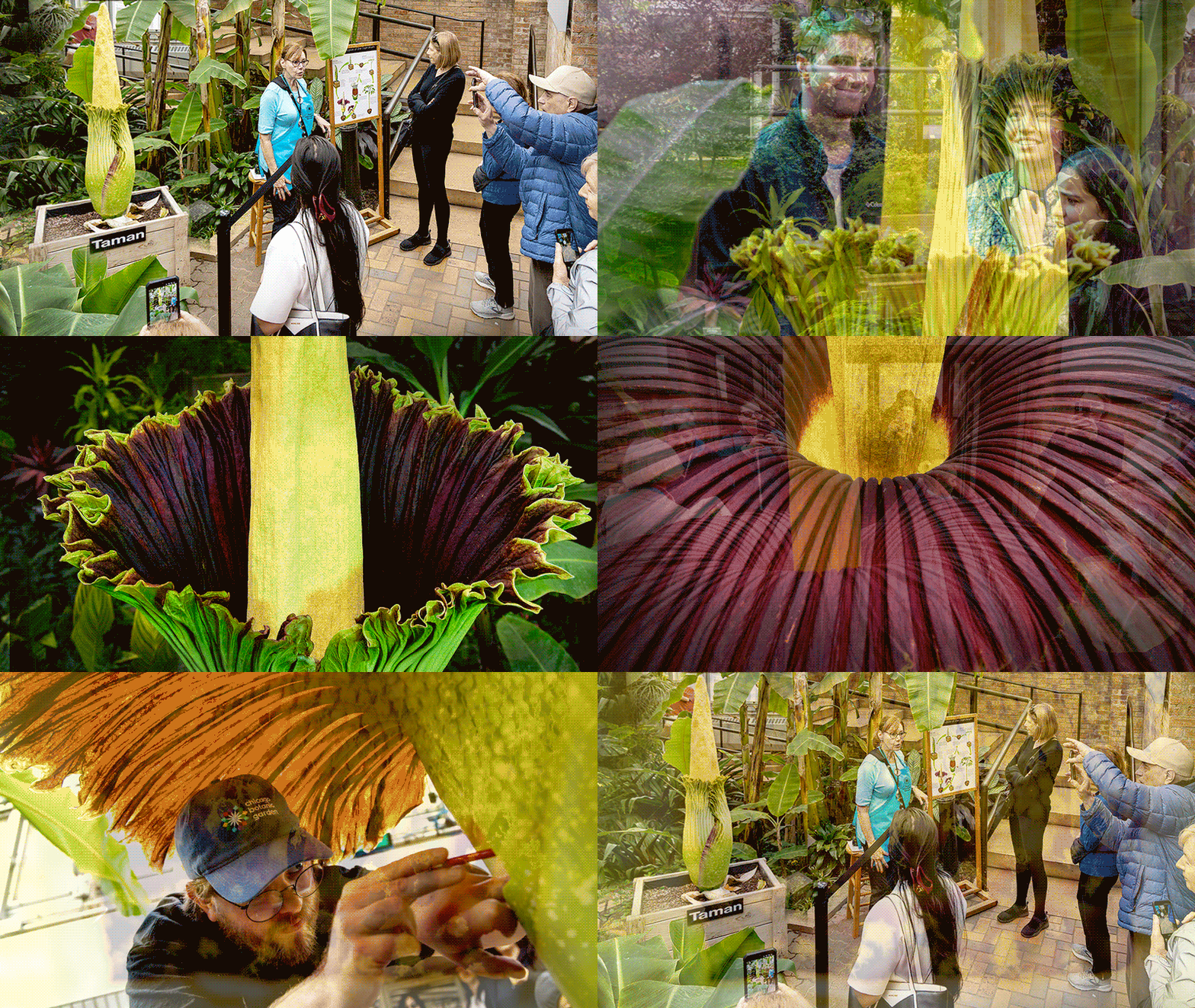
Taman's bloom in the Tropical Greenhouse, late April 2026
Maybe you heard the news or even visited to see it for yourself: our corpse flower (Amorphophallus titanum) named Taman bloomed in late April. While everyone’s eyes were on the fleeting inflorescence, a quieter story unfolded that's just as remarkable.
Taman's big moment may have passed, but look for relatives of the titan arum growing throughout the Garden. You may be surprised how many there are.
Are you a botanic garden interested in partnering with us on pollen banking? We'd love to hear from you. Reach out to Jeremy Foster.
It starts with a pinch of pollen.
Believe it or not, the corpse flowers in botanic gardens around the world are, in many cases, related to each other. Not distantly, but closely. It’s common that a collection starts from the same original plant or two, and when it comes time to pollinate a blooming plant, gardens have to work with what they have.
The result? Potential inbreeding or ineffective pollination.
Inbreeding in plants works much the same way it does in animals. When two closely related individuals reproduce, their offspring inherits a narrower slice of genetic diversity. Over time, that narrowing adds up. Plants become less vigorous, less resilient, and less able to handle stress—whether from disease or climate change. The stakes for this species are high: In their native Indonesia, roughly 72 percent of titan arum’s natural habitat has been degraded. Giving the species a fighting chance at a future requires bringing in fresh genetics from outside the family tree.
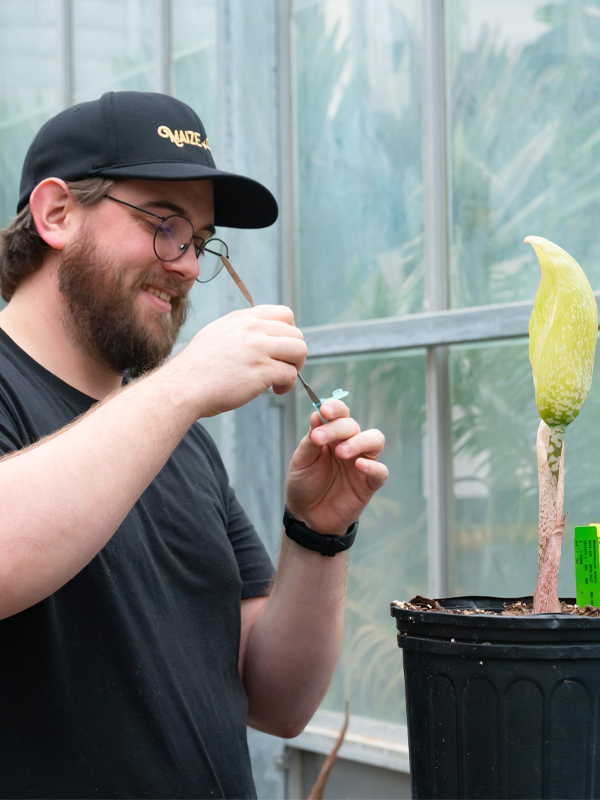
Jeremy Foster collecting pollen from another Amorphophallus species
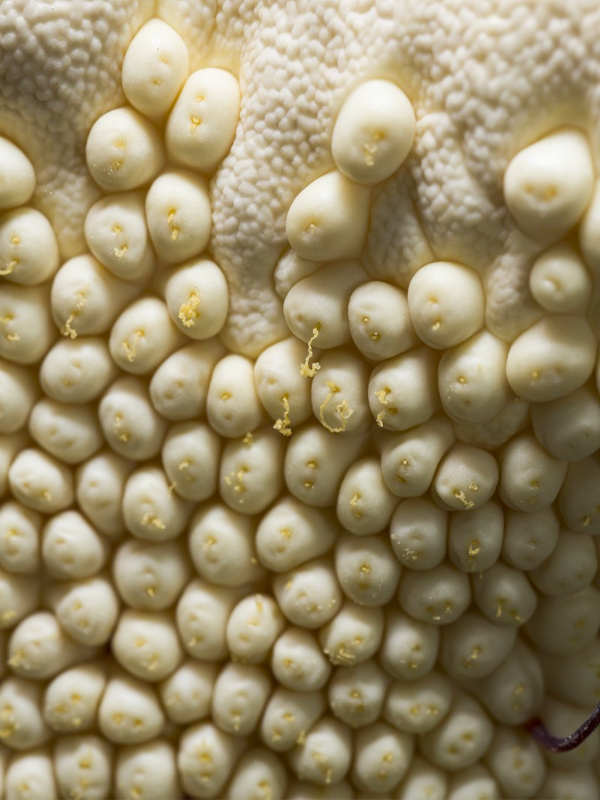
Male flowers releasing pollen
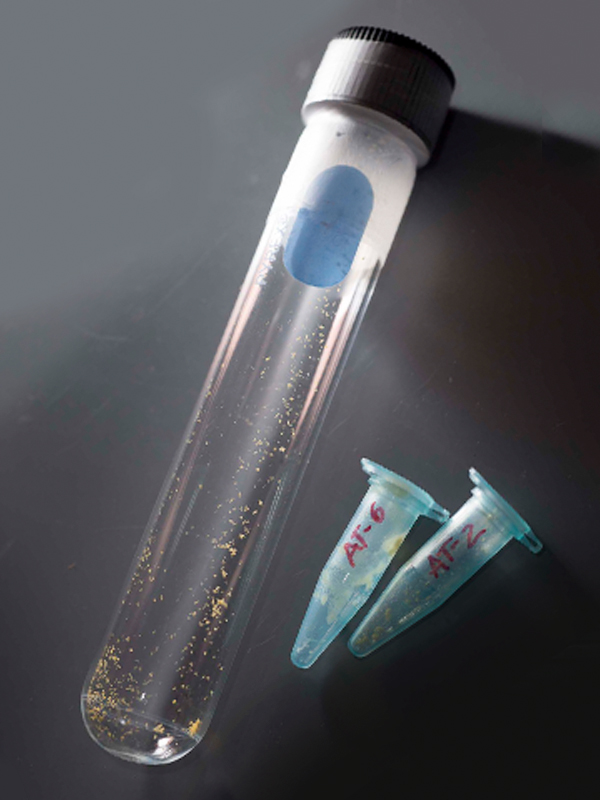
An Amorphophallus titanum pollen sample ready to be stored for future pollination.
This is where pollen offers a solution: different gardens could cross-pollinate their respective corpse flowers.
The logistics of cross-breeding titan arum plants is anything but simple. The plant takes seven to ten years to produce a single spike, and that hard-to-predict bloom only lasts around 48 hours. Getting two corpse flowers to bloom at the exact same time is basically like winning the botanical lottery—so rare it might as well be impossible. That leaves two options: either use pollen from the same flower, or play the long game and store pollen from another plant until the next one finally decides to bloom.
Pollen can be carefully dried, frozen, held in tiny tubes, and shipped across the world in something not much bigger than an envelope. Yet, the best methods for storing it are still being established. Historically, pollen banking efforts have focused on crops and horticultural species bred for commercial traits like color and fragrance, with only a handful of institutions turning their attention to wild species conservation. Garden scientists hope to change that, working to better understand how to store pollen from species of conservation concern while helping institutions around the world build their own pollen banking programs.
For plants like titan arum, whose seeds cannot be traditionally banked, pollen may be the most effective way to preserve their genetics across time and distance. Until recently, scientists were uncertain how long pollen could remain viable outside of a plant, as most samples last only a few days. But researchers at the Garden tested various storage methods and found they could keep pollen alive for nearly a year.
Last summer, this system was put to the test.
When the National Tropical Botanical Garden reached out about pollinating their titan arum, Pua Pilo, Pollen Bank Manager Jeremy Foster got to work tracing lineages and selecting the best possible genetic matches. He sent pollen collected from our titan arum plants—Sumatra, Ugly Duckling, and Taman—to give Pua Pilo the best possible chance at healthy, genetically diverse offspring.
Roughly nine months after pollination, a titan arum produces its fruit—a vividly red cluster of seeds. Those seeds can be grown into new corms, new plants, and eventually new blooms—ones that are stronger for the mixing. While Pua Pilo didn't produce fruit this time around, Foster hopes to expand these collaborative efforts across the more than 100 institutions that have a titan arum in their collection.
Foster’s published research supports what horticulturists are beginning to see in practice: greater genetic diversity in titan arums may mean healthier plants, compounding the benefit with every generation.
“This is one clear case where pollen banking can make all the difference, but it’s probably just the tip of the iceberg,” says Foster. “With our new Pollen Bank, the Garden is helping lead the way in using this approach for plant conservation, and we’re one of only a few places in the world doing it.”
How it works
From bloom to bank: collecting a corpse flower's pollen
1. Day one: catch the female flowers
When the inflorescence first opens, the female flowers at its base are receptive. This is the window to pollinate.
2. Set the traps
Small windows are cut into the spathe—the large petal-like sheath—and little foil trays are tucked underneath the male flowers, which sit higher up on the spike.
3. Overnight, the pollen falls
That night, the male flowers release their pollen. By the next morning, the foil trays have caught it and it’s ready to collect.
4. Test for viability
Pollen Bank Manager Jeremy Foster tests a tiny sample first to confirm the pollen is alive. The test is destructive; that sample can't be saved, so the rest is set aside untouched.
5. Dry carefully
The remaining pollen is dried to between 30 to 50 percent humidity over 24 to 48 hours. Then viability is tested again to make sure drying didn't damage it.
6. Divide and store
Viable pollen is divided into multiple small capsules so it can be shared with more than one garden, now or in the future.