

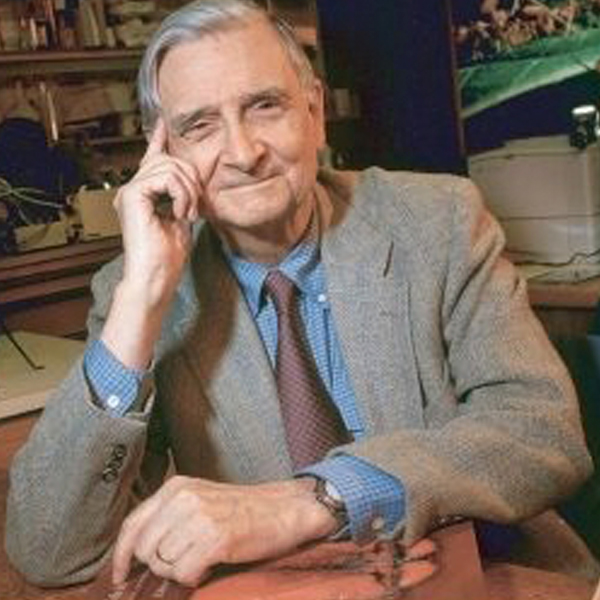
Edward Osborne Wilson
Years:
1929–2021
Year Hutchinson Medal awarded:
2004
Edward Osborne Wilson is considered the world’s leading authority on ants, having helped establish modern myrmecology. He is widely called the “father of biodiversity” for helping formalize the concept and championing conservation. He is one of the most impactful naturalists and scientific thinkers of the last century.
Wilson was a prolific science communicator whose books bridged science, philosophy, and human culture. Wilson received over 150 major international awards for his work. His influence spread across ecology, evolution, conservation, ethics, and science writing. Later in life, he became a leading voice in global conservation, especially concerned about mass extinction. His Half‑Earth proposal became a powerful call to action in climate and biodiversity policy discussions. His work continues to shape research, ethics, conservation policy, and how humans understand their place in nature.
Key Contributions:
- His landmark (and controversial) book Sociobiology: The New Synthesis proposed that animal—including human—social behavior has evolutionary and genetic foundations.
- He proposed the biophilia hypothesis, suggesting humans have an innate affinity for living systems.
Other Major Honors:
- National Medal of Science (1977)
- Pulitzer Prize (1979) for On Human Nature
- Crafoord Prize (1990) — biology’s equivalent to a Nobel
- Pulitzer Prize (1991) for The Ants
- International Prize for Biology (1993)
- Cosmos Prize (2012)
- Kew International Medal (2014)