



The Daniel F. and Ada L. Rice Plant Conservation Science Center
Inspired. Inspiring.
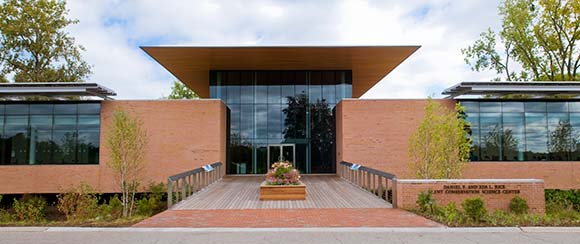
The Daniel F. and Ada L. Rice Plant Conservation Science Center provides laboratories and teaching facilities for scientists, ecologists, students, and volunteers whose research is critical to fulfilling the Garden’s efforts to save our planet by saving our plants. Awarded a Gold LEED rating by the U.S. Green Building Council, the 38,000-square-foot Plant Science Center also serves as home to a unique doctoral program in plant biology and conservation with Northwestern University and as headquarters for the Garden’s international efforts in plant conservation. A viewing gallery and the 16,000-square-foot Green Roof Garden are open to the public, giving nearly 800,000 visitors and schoolchildren each year the opportunity to view plant science firsthand.
View open hours here.
The Laboratories
The Plant Science Center contains the following laboratories: the ITW Plant Systematics Laboratory and the Nancy Poole Rich Herbarium; the Josephine P. & John J. Louis Foundation Microscopy Lab and GIS Facility; the Population Biology Laboratory; the Abbott Ecology Laboratory; the Soil Laboratory and Soil Preparation Laboratory; the Dixon National Tallgrass Prairie Seed Bank Preparation Laboratory and Seed Bank, along with the Dr. Scholl Foundation Seed Quarantine Chamber; the Reproductive Biology Laboratory; the Astellas Economic Botany Laboratory; and the Harris Family Foundation Plant Genetics Laboratory. Two growth chambers (funded by the D & R Fund) are in the Population Biology and Ecology laboratories.
Other features
The entrance to the Plant Science Center begins with a 40-foot-long, gently sloping wooden bridge over the Rainwater Glen that surrounds the building. Inside, a 25-foot-high Grainger Gallery runs the length of the Plant Science Center, with the laboratories visible on either side. In addition to the labs, the Plant Science Center houses the Lenhardt Plant Science Library for scientific journals and books, and a seminar suite for academic meetings and conferences.
Sustainability
The Chicago Botanic Garden has earned a Gold LEED rating from the U.S. Green Building Council for the Daniel F. and Ada L. Rice Plant Conservation Science Center. LEED is the nationally accepted benchmark for the design, construction, and operation of high-performance green buildings. The Plant Science Center, which opened in September 2009, received points in six major categories including sustainable sites, water efficiency, energy and atmosphere, material and resources, indoor environmental quality, and innovation and design process. LEED standards increase initial building costs but decrease long-term operating expenses; by choosing to build this way, the Garden demonstrates its ongoing commitment to sustainable building and development practices.
As a result of its environmentally responsible, energy- conserving design, the Plant Science Center offers conservation scientists a streamlined, energy-efficient workplace that has a minimal impact on the surrounding land and lakes. It also affords visitors a chance to observe up close how such inspired design can combine a sense of responsibility with beauty and function.